


Upcoming events, media moves + news, Labor Day recs

Insights
Thought Leadership
August 28, 2025
Today: Some quick media moves, news and several exciting upcoming events to ponder as you ride out the last wave of summer. And because it can’t be all work and no play, revisit Global Gateway Advisors’ Summer Edit for inspiration on what to read, watch or listen to this long weekend.
ICYMI: The last edition of COMPASS introduced OK Today, a global, youth-driven collective working to change how the world sees and talks about mental health through dialogue, education, community and culture. Learn more and get involved here.
Events: What’s coming up in September
Technology & Innovation
- Fortune Brainstorm Tech (Park City, UT, Sept. 8-10): Join the top leaders in tech — including clients and event speakers Brad Anderson, President Products, User Experience Engineering and Security, Qualtrics and Anthony Moisant, CIO and CSO of Indeed – to discuss the role of technology in society and topics from AI and cybersecurity to fintech, crypto and defense tech. The evening prior to the event, Zig Serafin, CEO, Qualtrics, will co-host a Fortune CEOi private dinner with Diane Brady, Executive Editorial Director, Fortune. More here – Will you be on site? Let us know so we can meet up!
- WSJ Technology Council Summit (New York City, Sept. 15-16): Industry leaders including Carolina Dybeck Happe, COO of Microsoft; Anthony Moisant, CIO and CSO of Indeed; and Severin Hacker, cofounder and CEO of Duolingo, will convene to explore how AI’s rapid rise is reshaping companies, industries and jobs through interviews, discussions and networking. More here
- Fast Company Innovation Festival (New York City, Sept. 15-18): Join innovators, entrepreneurs, and creatives including Justin McLeod, founder and CEO of Hinge; Brian Niccol, chairman and CEO of Starbucks; and Ego Nwodim, actress, comedian, and SNL cast member, for four days of talks, workshops, and experiences exploring the future of business, technology, design and culture. More here
- Axios AI+ Summit (Washington, D.C., Sept. 17): Examine the forces driving the global race to dominate AI, the business landscape it is reshaping, and the policy challenges emerging as breakthroughs outpace regulation and leaders race to balance innovation with oversight. More here
Executive Leadership & Finance
- Gartner CFO + Finance Executive Conference (London, Sept. 10-11): Finance leaders will tackle risk, efficiency and growth in uncertain times, with keynotes from polar explorer and climate tech investor Ben Saunders and futurologist Magnus Lindkvist. More here
- Forbes CMO Summit (Aspen, Colorado, Sept. 16-18): An exclusive gathering for top marketing leaders, the Forbes CMO Summit fosters candid, Chatham House Rule discussions on growth and brand leadership, with speakers including Zena Arnold, CMO, Sephora U.S.; John Gerzema, CEO, The Harris Poll; Zach Kitschke, CMO, Canva; and Marian Lee, CMO, Netflix. More here
Ideas, Media & Policy
- The Atlantic Festival (New York City, Sept. 18-20): Discussions with leading thinkers and cultural icons — including Scott Galloway, Jeffrey Goldberg and Keri Russell — along with exclusive book readings, film screenings and performances. More here
Health & Biotech
- Fierce Pharma Week (Philadelphia, Sept. 8-11): Top pharma leaders — including attendees from Pfizer, Johnson & Johnson, AstraZeneca, Merck and Novartis — will meet for a week of strategy and innovation in Philadelphia. More here
- LSX World Congress USA (Boston, Sept. 16-17): Join leaders from biotech, medtech and healthtech to showcase innovation, forge partnerships and shape the future of healthcare technology — with attendees from companies including Pfizer, Johnson & Johnson, AstraZeneca, Novartis, Eli Lilly, Merck, Philips and Stryker. More here
- Modern Healthcare Leadership Summit (Washington, D.C., Sept. 25): C-suite executives and key decision-makers will gather to tackle challenges from AI integration to value-based care, sharing practical insights to improve financial and operational performance, with speakers including Peter Arduini, CEO, GE HealthCare; David Rhew, MD, global chief medical officer, Microsoft; and Micky Tripathi, chief AI implementation officer, Mayo Clinic. More here
Bookmark Global Gateway Advisors’ event tracker, updated weekly.
Media news + moves
- The anchor exodus: The trend of news anchors leaving mainstream media continues, with Don Lemon, Joy Reid, Chuck Todd and Jim Acosta among those finding they can operate more freely — and often earn more — in the independent realm of Substacks, YouTube and podcasts, further fragmenting the traditional media landscape. Some, however, see it as the pendulum swinging back: ‘It feels to me like we are going back to valuing traditional beat reporters,’ said Alison Pepper, a former CBS News talent executive and CAA agent. Keep reading
- Truth isn’t totally dead: Jessica Yellin, independent journalist and former CNN White House Correspondent, argues that as more Americans turn to social and video platforms for news amid rising AI-driven misinformation, “evidence-based creators” have become essential truth-tellers — but they need stronger frameworks, resources and ties to legacy media to endure. Keep reading
- A month of changing logos: While Cracker Barrel grabs headlines, MSNBC is also rebranding — dropping the peacock and adopting My Source News Opinion World, or simply MS NOW. Keep reading
The argument for the left: Former Atlantic staff writer Jerusalem Demsas has launched The Argument, a new publication (on Substack, naturally) aimed at bolstering the ideas and arguments of modern liberalism and convincing readers of their importance and value. It has already raised roughly $4 million at a $20 million valuation and attracted an impressive slew of contributors including Matt Yglesias, Rachael Bedard and Derek Thompson. Read Demsas’ welcome letter here - Hiring: The Wall Street Journal is seeking a Talent Coach for a new development program intended to equip journalists with advanced skills in content creation and audience engagement. Learn more
The latest in AI:
- A cautionary tale: AI can fool anyone — even the editors of a tech-centric outlet like WIRED, who had to retract a seemingly perfect but ultimately AI-fabricated pitch. Keep reading
- A new standard for compensation: Perplexity, the startup building an artificial intelligence search engine to rival Google — and recently in the spotlight after offering to buy Chrome — is giving publishers the chance to earn revenue from the articles their content generates. ‘AI is helping to create a better internet, but publishers still need to get paid,’ said CEO Aravind Srinivas. The company has earmarked $42.5 million to distribute through the program. Keep reading
The latest in Inclusion:
- Global employers caught in a DEI crossfire: In the U.S., the Trump administration has rolled back diversity policies with executive orders declaring many initiatives “illegal DEI,” while Europe, the U.K., Japan and Australia are moving in the opposite direction with mandates on pay transparency, board quotas and equity reporting. The result is a fragmented global landscape where a one-size-fits-all strategy is nearly impossible, pushing employers to tailor policies by region — and to communicate those strategies with careful, intentional messaging both internally and externally. Keep reading
- LGBTQ+ inclusion drives long-term growth: A new analysis by the Human Rights Campaign Foundation found that companies with long-standing LGBTQ+ inclusive policies delivered stronger financial results over time — including higher revenue growth, net income and market stability. Keep reading
- Scientists drop diversity language: To avoid scrutiny from the Trump administration, scientists are modifying grant applications by removing terms like “diverse” and “underrepresented.” Longtime researchers say this level of language policing — which even affects scientific contexts such as “diverse airborne toxicants” — is unprecedented. Still, there’s no real alternative to funding from the National Institutes of Health, which provided nearly $37 billion in the last fiscal year. Keep reading
- Drop in Women Leaders Across U.S. Corporations: Against the backdrop of Trump-era executive orders dismantling DEI programs, the number of women in leadership positions in the U.S. has fallen. Keep reading
Track key changes in diversity, equity and inclusion — updated in real time — here.
Media moves:
- TechCrunch hired Russell Brandom as artificial intelligence editor.
- Alexis Sobel Fitts was named a senior assignment editor overseeing technology and media coverage at The Washington Post.
- Bloomberg News hired Judy Lagrou as a reporter, while senior reporter Lindsay Dodgson has left the news organization.
- Katie Roof will join The Information as Deputy Bureau Chief of the venture capital section after being “poached” from Bloomberg, while Sri Muppidi will expand to become a beat reporter on OpenAI and Anthropic.
- Charles Forelle is being positioned to be the next editor in chief of Barron’s, per Oliver Darcy of Status.
- The Wall Street Journal has hired Lydia Wheeler as a legal affairs reporter, while both Marie Beaudette and Denny Jacob are departing the news organization.
- Fierce Healthcare reporter Noah Tong left the news organization for a new opportunity.
- Axios health care policy reporter Victoria Knight left the news organization.
Featured Insights

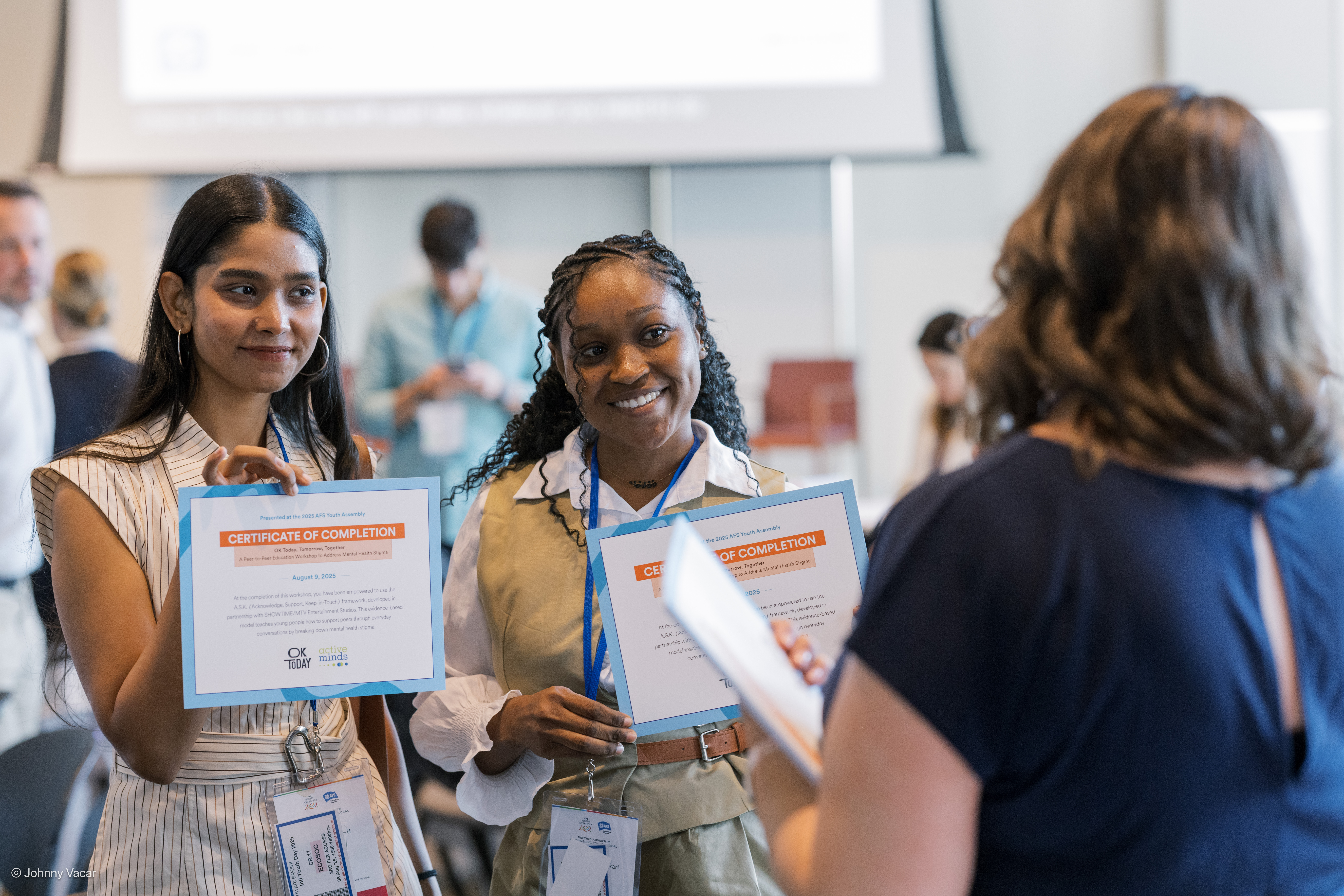
OK Today debuts at the 2025 AFS Youth Assembly
Insights
Thought Leadership
August 14, 2025
Young adults are struggling.
Globally, one in seven youth live with a mental health condition, and many face stigma, isolation and a lack of support. Rates of anxiety, depression and stress are rising, often leaving youth unsure where to turn.
That’s why we’re taking action.
We’re proud to announce the launch of OK Today, a global, youth-driven collective on a mission to transform how the world sees and talks about mental health. It debuted at the 2025 AFS Youth Assembly this past weekend. More on that, and how your organization can get involved, below.
Plus: Is corporate activism making a comeback? The numbers say yes.
ICYMI: People are no longer “Googling it,” they’re turning to AI chatbots and overviews for answers. But where do these tools get the information they’re sharing? We dive into AI’s media diet in our recent newsletter. Read it here.
Breaking down stigma one conversation at a time
There’s no single cause of the youth mental health crisis. A mix of factors — smartphone use, social media, political polarization, the lingering effects of COVID isolation and remote learning, climate change, rising living costs and global instability — have all contributed.
Go deeper: However, the real crisis isn’t just how youth feel; it’s what they’re afraid to express. Four in 10 Gen Z individuals say they feel judged or misunderstood when discussing mental health at school or work. That silence blocks real progress.
OK Today is a peer-powered platform that is working to change how the world sees and talks about mental health. We believe everyone deserves space to show up as their authentic self, whether we’re OK or not OK, and know that is OK. We are breaking down stigma through:
- Dialogue: encouraging everyday conversations around mental health.
- Education: equipping youth changemakers with tools to break down stigma through community building and advocacy.
- Community: investing in youth-led ideas to improve mental health at the community level.
- Culture: creating a culture where mental health conversations are normalized.
How it works: OK Today is built on the belief that young people, ages 18-25, should be leading the mental health conversation. We’re guided by a Youth Advisory Board of young people from across the globe. Meet them here!
2025 AFS Youth Assembly + OK Today
For the first time in the Youth Assembly’s history, mental health was featured as a core program track — a powerful signal that it’s not a side issue, but central to how young people experience the world, navigate crises and shape their future.
That focus was reflected in the conversations, participation and data we shared throughout the event, where OK Today championed a weekend of activations, workshops and community-building moments.
By the numbers: Research shows that 67% of young people will tell a friend they’re struggling before telling anyone else, yet 70% feel unequipped to help a friend dealing with mental health challenges.
Taking action: In an OK Today-sponsored session moderated by Active Minds, a peer-to-peer education advisor to OK Today, participants learned how to support peers in need using the A.S.K. (Acknowledge, Support, Keep-In-Touch) framework. They practiced real-life scenarios, shared personal experiences and walked away with tangible skills to use in their own communities.
Leading dialogue: A panel discussion titled “Beyond the Surface: The Global Mental Health Crisis” explored how global crises, from armed conflict to pandemics to climate change, are impacting youth mental health. Experts and youth advocates discussed solutions ranging from peer-led support and journaling to gender-sensitive policies and community-driven action. The panel highlighted the role of storytelling, early intervention and empowering young people to drive meaningful change.
“The solutions to mental health challenges arise from love, genuine care and a profound sense of empathy,” said Eduardo Vasconcelos Goyanna Filho, panelist and director of youth engagement at the Stavros Niarchos Foundation Global Center for Child and Adolescent Mental Health.
Join us in our goal of reaching 1 million young people in the next three years.
- Become a partner. We’re looking for nonprofit and funding partners to help scale the impact of OK Today. Join us to help build and grow OK Today programming, drive campaigns at key moments and be a part of our next global, youth-driven event. Get in touch at OKToday@gga.nyc.
- Subscribe to our youth mental health newsletter for regular updates on what we’re doing, and for broader trends in youth mental health.
- Connect with us on Instagram and LinkedIn.
Is corporate activism back?
Last week, Bentley University-Gallup released a report which found that 51% of U.S. adults believe companies should take a public stance on current issues; a Pew Research poll released the same week found similar results. We looked into Gallup’s findings:
By the numbers: While there’s nothing decisive about 51%, it marks a 13-point increase from 38% in 2024.
- Sixty percent of 18- to 29-year-olds want to hear from businesses, with that number decreasing in each older age group.
- Seventy-one percent of Democrats support businesses taking public stances, compared to 33% of Republicans.
What issues matter the most? When given 12 topics companies could address, more than 50% of respondents supported companies speaking out on the following, respectively: free speech, climate change, mental health, diversity, equity and inclusion and healthcare. Just 33% supported companies taking a stance on international conflicts, 26% on abortion, and 18% on religion.
Yes, but: While a slight majority of consumers want companies to speak out on current events, only 40% of employees want their employers to discuss these issues with them.
The bottom line: We help organizations develop custom rubrics to determine whether and how they should engage internally or externally on social issues and current events. Interested? Reach out to info@gga.nyc.
Media news + moves
What we’re reading and watching:
- The buzz about Beehiiv: Substack is ubiquitous, but many writers are choosing Beehiiv for its customization options and pricing. “I chose Beehiiv over Substack for my new AI and book-focused newsletter for several reasons — product, economics, and more. One of the biggest? I didn’t want to be just another same-looking Substack,” said Wall Street Journal columnist Joanna Stern. Meanwhile, The Information is asking whether Beehiiv could be the next billion-dollar newsletter startup. More on that here
- An unexpected win for Reddit: Reddit’s defining feature is human conversation — exactly the kind of content AI seeks. Thanks to licensing deals with OpenAI and Google, Reddit is a top-cited source for queries from ChatGPT, Perplexity and Google Gemini, appearing in 5.5% of Google’s AI Overview responses. “Human conversation is not being replaced by AI, instead, it’s becoming more important,” Reddit CEO Steve Huffman said in a recent earnings call. Continue reading
- Behold the Gray Lady: While many media companies struggle, the New York Times is thriving, with its stock hitting an all-time high earlier this month and Q2 revenue up 27.8% year over year. It has stayed competitive by producing more video content and signing an AI-related licensing deal with Amazon. Read more
- Semafor considers its next move. It’s been just over two years since Semafor’s last infusion of outside funding, and it may be gearing up for another round, Oliver Darcy reported in his Status newsletter. Learn more
- Business Insider founder launches podcast: Henry Blodget launches “Solutions” next Monday, a new podcast series produced with Vox that highlights experts tackling major challenges in science, business and society. Bookmark to listen here
Media moves:
- Business Insider hired Zak Jason as executive editor for its Discourse section.
- Yahoo Finance hired JR Whalen as a news and personal finance producer, while Jordan Weissmann announced he is leaving the organization.
- Bloomberg News hired Charles Gorrivan as a reporter, while editor Kevin Miller left the organization after nearly 30 years.
- MarketWatch hired Christine Ji to cover Big Tech.
- Fast Company promoted Christopher Zara to news director.
- The New York Times hired Erik Wemple to cover media news for the business section and Sandhya Somashekhar as its Washington bureau domestic policy editor.
- The Information hired Katie Roof as deputy bureau chief of venture capital coverage.
- Bloomberg Industry Group hired Keith L. Alexander as editor-at-large.
Featured Insights

Inside AI’s media diet
Insights
Thought Leadership
July 30, 2025
The way we find information online is shifting fast. Browser-based AI search has more than doubled since June 2024, now accounting for 5.6% of all search traffic. This transition is disrupting how information is discovered, how publishers drive traffic and how brands reach their audiences.
In today’s edition, we take a closer look at a new report from Muck Rack, the media intelligence platform, called “What Is AI Reading?”
ICYMI: We crowdsourced newsletter, podcast, book, TV and movie recommendations from our team and friends of the firm. Click here to explore the picks that are inspiring and informing them this summer.
The content that feeds AI
Muck Rack’s new report analyzed over 500,000 user prompts — covering a wide range of industries and topics — entered into ChatGPT, Gemini and Claude to better understand the characteristics of AI-generated citations across various contexts. Here’s what communications professionals need to know.
1. Earned media matters
AI cites non-paid media more than 95% of the time. Corporate blogs and journalism lead, while social and marketing content and press releases account for just 2% and 1% of citations, respectively.
- What they’re saying: “Based on the data, we can see that the models are pretty clearly avoiding marketing materials,” said Matt Dzugan, senior director of data at Muck Rack. “Essentially, the models are trying to earn the trust of [their] audience and don’t want to regurgitate salesy materials.”
- Go deeper: Generative engine optimization (GEO) is quickly replacing search engine optimization (SEO). By 2026, SEO is expected to drop by 25% as more people turn to AI chatbots and Google’s AI-generated responses, according to Gartner. Read our deep dive on how to win in GEO.
2. Fresh is favored
Among journalism sources cited, there was a clear preference for stories published within the past 12 months.
- By the numbers: 56% of journalism citations by OpenAI were published in the last year.
3. Outlet authority
The most frequently cited news organizations include the Associated Press, Reuters, Axios, the Financial Times, Forbes and Time — several of which have formal partnerships with large language models.
- Yes, but: When asked about specific industries, AI often turns to niche and trade publications, as well as Wikipedia, which ChatGPT consistently cites for industry-specific trends.
The bottom line: As LLMs undergo updates and retraining, this space will continue to evolve quickly. Communicators must stay on top of how AI finds, filters and cites information in order to remain visible, credible and competitive. Download the full report from Muck Rack here.
Media news + moves
What we’re reading and watching:
- Substack raises $100 million in Series C funding: The latest funding round values the platform at $1.1 billion. “We’re doubling down on the Substack app, which is designed to help audiences reclaim their attention and connect with the creators they care about,” its founders wrote in a post. Read it in full here.
- Fortune launches ‘Success’ newsletter: Written by Orianna Rosa Royle, the weekly newsletter will share lessons from top CEOs, career trends, and rituals and habits that drive real change. Subscribe here.
- A ‘new era’ for WIRED: Going forward, the publication will focus on connecting readers more directly to its journalism and reporters through five weekly newsletters, twice-monthly livestream AMAs, comments sections and subscriber-only narrated articles. Editorial director Katie Drummond called the effort a “solution to this so-called ‘traffic apocalypse’ and the AI sloppification of the internet.” Learn about the new newsletters + subscribe to them here.
- The power of the pod: New York-based podcast startup Kaleidoscope, which heavily features science and tech content, completed its Series A, raising $5 million. Keep an eye out for a new investigative series on Othram, the genetic forensics lab behind key breakthroughs in the Gilgo Beach murders and Idaho college killings. Learn more.
- A $200 million valuation for The Free Press? Bari Weiss, currently in talks about a sale with David Ellison, the incoming owner of CBS News, is seeking that amount for her three-year-old media startup. For context, Jeff Bezos paid $250 million for the Washington Post in 2013, unadjusted for inflation. Learn more.
- The Economist’s first AI deal: The outlet has partnered with Google’s NotebookLM. More here.
Media moves:
- Bloomberg News hired Nikki Waller as managing editor of equality and work. The enterprise also added Andrew Mendez as a breaking news editor in its San Francisco bureau, and Dhruv Mehrotra, formerly an investigative data reporter at WIRED.
- David Cho was hired by CNBC to be its editor in chief, while news leaders Dan Colarusso and Jay Yarow announced they are leaving the organization.
- Amanda Freidman joined Politico as a health care reporter, covering the surgeon general and writing the Pro Health Care PM newsletter.
- Politico also hired Noah Baustin as an energy and environment reporter.
- Brandon Doerrer was named creativity and media innovation reporter at Ad Age.
- The Wall Street Journalhired Jaclyn Jeffrey-Wilensky as a data reporter.
- Yahoo Finance hired Francisco Velasquez as a reporter.
- The Financial Times hired Julie Steinberg as a property correspondent.
- Business Insider senior editor Clementine Fletcher left the organization.
Featured Insights
Leaning into LinkedIn
Insights
Thought Leadership
June 25, 2025
“The content that creates a memory is the content that drives action.”
That’s the message from LinkedIn’s head of customer insights, Nicole Moreo. We sat down with her this week to learn more. With over 1 billion users, including 8.2 million C-level executives, LinkedIn continues to evolve as a powerful and cost-effective tool for building brand visibility, trust and influence, and shaping industry dialogue.
Executives are creating consistent, expert, human content that resonates long after the scroll. In today’s newsletter, we explore why LinkedIn is more essential than ever and how to lean into the latest trends to reach your most important audiences.
ICYMI: The previous edition of COMPASS explored why organizations should embrace generative engine optimization (GEO), as traditional search engine optimization (SEO) declines amid the rise of AI chatbots and Google’s AI-generated results. Read it here.
Why CEOs and leaders should all be active on LinkedIn
The platform offers thought leaders a powerful hub with multiple ways to advance business goals — delivering strong returns on time invested. And as one’s personal profile gains visibility, so does their company’s brand and impact.
1. Establish presence, authenticity and credibility
People prefer hearing directly from executives rather than brands. CEOs active on LinkedIn humanize their companies, building trust, enhancing authenticity and expanding their influence. Executive posts also tend to generate higher engagement and shares than brand posts.
- Executives are building trust with direct-to-audience video. According to Moreo: “We’ve seen video make a huge difference in true business return.” Short, informal walk-and-talk videos are more authentic and memorable.
- Video also creates what LinkedIn calls dwell time — the most important metric for platform performance and eventual conversion.
Measure it: A rise in profile views indicates your content is resonating, and dwell time is the new impression. LinkedIn’s latest data show that how long someone engages with your content (not how many people see it) is a leading predictor of conversion.
Who is doing it well? Jon Gray, COO at Blackstone, is known for sharing business and personal insightsin a casual tone — he’s often on a run! — which makes him feel relatable while strengthening his professional brand.
- Others we’re watching: Chris Kempczinski, CEO, McDonald’s; Aparna Chennapragada, chief product officer, Microsoft; and Carlos Abrams-Rivera, CEO, Kraft Heinz.
2. Gain unparalleled access to decision makers
LinkedIn’s user base has nearly doubled since 2019, significantly growing its network of C-suite leaders, influencers and key decision-makers who use the network to seek expert insights, collaboration opportunities and fresh ideas. And 91% of executives consider LinkedIn their top source for professionally relevant content.
Why it matters:
- Directly engage senior stakeholders in conversations, skipping intermediaries and delays.
- Connect with decision-makers in target industries and sectors.
- Access to relevant groups and forums where industry leaders drive key conversations and influence trends.
3. Attract top talent
According to LinkedIn data, 75% of job seekers evaluate an employer’s brand before applying. Gen Z engagement on LinkedIn is growing fast, and “Gen Z is more likely to follow people than brands,” Moreo said.
Why it matters: Organizations with a strong executive presence that highlights company culture and values attract higher-quality candidates.
- Candidates are drawn to workplaces that align with their values and offer a supportive culture — priorities that matter even more to Gen Z, who will make up 30% of the workforce by 2030.
4. Lead generation
The unique combination of professional data, advanced search filters and content-driven engagement positions LinkedIn as a top platform for generating high-quality leads.
Marketing and communications teams must think beyond the funnel, says Moreo. At any given time, only 5% of your audience is actively in-market –- the other 95% isn’t ready to buy, but is ready to remember you. That’s why brand-building content on LinkedIn matters. “You have to create a memory when they don’t even realize they need you,” said Moreo.
- By the numbers: LinkedIn accounts for 80% of all B2B leads generated through social media.
5. Supplement traditional comms channels
Thought leaders increasingly use LinkedIn to sidestep conventional avenues like press releases or media interviews, allowing them to speak directly to their audiences — faster, more authentically and with greater control.
In action: Tinder CEO Faye Iosotaluno recently announced her plans to step down via LinkedIn. Match Group CEO Spencer Rascoff responded, thanking her and noting that he will be stepping in to lead Tinder. Media reporting the news then linked directly to Iosotaluno’s post.
The bottom line: LinkedIn has evolved to become a public mainstage for executive thought leadership. The most effective voices are the most consistent, human and memorable. Whether you’re sharing insights, announcing a bold move, or just showing up, every post is an opportunity to shape reputation and build trust.
Global Gateway Advisors helps leaders communicate with clarity through smart, resonant content strategies tailored to your goals and your audience. Get in touch to elevate your executive presence.
AFS Youth Assembly: Empowering global citizens
Hundreds of delegates aged 18–35 representing over 100 countries will gather in New York City Aug. 8-10 for the AFS Youth Assembly, a global platform dedicated to developing the next generation of leaders through cross-cultural exchange, education and action. If you would like to send someone from your organization, apply by Aug. 1.
What to watch: In response to the global youth mental health crisis, the Assembly is launching a dedicated program track on mental health for the first time. Global Gateway Advisors is proud to support this important initiative by fostering strategic dialogue and amplifying youth-led solutions to break down mental health stigma globally.
Click here to receive our weekly newsletter for youth mental health insights and solutions.
Upcoming events
- Aspen Ideas Festival (Aspen, Colo., June 25-July 1) Leaders and thinkers gather at this annual event to explore critical issues and ignite new ideas around themes like prosperity reimagined; the global contract; breakthroughs and innovations; and what it means to live a good life. Speakers include Susan Rice, former U.S. domestic policy adviser; Fred Krupp, president, Environmental Defense Fund; Brené Brown, research professor and author; and Laurence Fink, chairman and CEO, BlackRock. More here.
- American Hospital Association Leadership Summit (Nashville, Tenn., July 20-22) Senior health care executives, clinicians, and industry experts convene to explore strategies for delivering higher-value care, ensuring financial sustainability, tackling workforce challenges and enhancing the consumer experience. More here.
- Fortune Brainstorm AI Singapore (Singapore, July 22-23) This year’s event focuses on the rise of AI agents, the shift from AI planning to implementation and the urgent need for sustainable, responsible scaling. Featured speakers include Tan Su Shan, CEO, DBS Bank; Oliver Jay, managing director, international, OpenAI; and Madhu Kurup, vice president of engineering, Indeed. More here.
Bookmark Global Gateway Advisors’ event tracker, updated weekly.
Media news + moves
What we’re reading and watching:
- News sites feel the impact of AI search results: As more people rely on chatbot responses for information, news sites are seeing a significant drop in organic search traffic. When Business Insider laid off 21% of its staff last month, CEO Barbara Peng cited "extreme traffic drops;” data show a 55% decline between April 2022 and April 2025. Read more.
- Bloomberg Television announces expansion this month: The new launches include Bloomberg Tech: Asia and Bloomberg Tech: Europe. Read more.
- Social media surpasses TV for the first time in the U.S.: According to a new digital report from Oxford’s Reuters Institute, the proportion of Americans accessing news via social media and video networks (54%) is “sharply up,” outpacing both TV news (50%) and news websites/apps (48%) for the first time. Read more.
- The Atlantic goes on a hiring spree: With many in the industry heading to Substack — where dozens of writers now earn over $1 million a year — The Atlantic is offering salaries of up to $300,000, with several hires coming from the Washington Post. Read more.
- Introducing Fortune AIQ: A new series exploring how businesses are adopting AI with a thoughtful, strategic approach — hence the “IQ.” Read more.
- A new podcast from NBC News: “Here’s the Scoop,” hosted by Morgan Chesky, Brian Cheung and Yasmin Vossoughian will mix deep dives with quick news rundowns every day at 5 p.m. ET. Read more.
- TechCrunch isn’t leaving Europe after all: According to Michael Reinstein, chairman and founder of private equity firm Regent, which recently bought TechCrunch, the plan is not to retreat, as widely reported, but to “double down.” Read more.
- Subscriptions surge at The Economist: The outlet said it reached its "highest-ever number of subscriptions" in 2025. Read more.
- The BBC considers charging Americans: Executives are considering charging U.S. consumers for access to help shore up finances, seeing the country’s media polarization as an opportunity to attract audiences with impartial coverage. Read more.
The Substack takeover continues:
- Derek Thompson, longtime staff writer at The Atlantic, joined the platform: The move comes on the heels of his new book. “...I felt like maybe the best way for me to say all the things that I have to say about this one thing in my life, the fallout of and potential of ‘Abundance,’ the best way to do that was to do so as an independent journalist and not as a sort of de facto semi-political actor working for a non-political institution,” Thompson said. Read more.
- Former ABC anchor Terry Moran made the jump, too: The longtime anchor and correspondent was dropped by the network after calling Trump a “world-class hater.” He subsequently launched a Substack, making the announcement in a video titled “Independence Day.” Read more.
- News anchors embrace the side hustle: Recent Indeed data revealed that 52% of professionals said they have to take on secondary jobs to make ends meet. Among them are TV news anchors, as networks grow more flexible with staff experimenting with content distribution on Substack. “They’re opening the door because talent who’s left had such immediate impact on Substack,” said Catherine Valentine, Substack’s head of news and politics, of the shift. Read more.
Media moves:
- Axios hired Madison Mills as a senior markets reporter and author of the daily Axios Markets newsletter.
- Fortune promoted Emma Hinchliffe to its Most Powerful Women Editor.
- Business Insider hired Kim Last as editorial director of its news events business, of BI Live.
- Steven Tweedie was named deputy executive editor at Business Insider.
- TechCrunch reporter Rebecca Bellan is now covering artificial intelligence.
- Bloomberg News hired Patrick Howell O’Neill as a cybersecurity reporter.
- Business Insider hired Julia Herbst as senior leadership and workplace editor.
- Reporter Brian Delk joined Business Insider’seconomy team.
- The Los Angeles Times hired Eric Bellman as deputy business editor,
- Adam O’Neal was hired as opinion editor at The Washington Post.
- Maxine Joselow joined the climate desk at The New York Times.
- Emma Haidar joined the Bloomberg News Work + Management team as a summer intern.
[/vc_column_text]